Among Yellowstone’s Gray Wolves: A Meeting With Wilderness
It's hard to forget your first wolf sighting. For me, it was as if laying eyes on nature’s most divisive carnivore narrowed the gap between my lofty human ego and the raw earth beneath my boots.
Our journey began as nine strangers, each chasing our own idea of a wildlife adventure in Yellowstone National Park, the world’s first and among its most famous. For a week in mid-March, we were in the hands of Wolftracker, a Montana-based guiding business run by biologists Nathan Varley and Linda Thurston. Alongside our three guides was Doug Smith, a renowned wolf biologist and National Geographic Explorer, who joined us for several dinnerside presentations as well as one memorable day in the field.
First Light on the Plateau
Tipped off about wolf sightings the evening before, our guides chose the Blacktail Plateau for that day’s first stop. One of them, a man in his twenties with a green ball cap and a notable penchant for wolves, pulled his binoculars from his chest harness and glassed the wild land stretching beyond the parking lot. Smith and the two other guides, women whose patience and hard-earned understanding of the landscape showed in how they carried themselves, left the vans and joined him in the search. I climbed out as well, knowing full well that my only contributions were my ears and my presence.
The frigid mountain air nipped at my cheeks, and a spring breeze whirred across the plateau, joining a muted symphony of ravens, mountain bluebirds and chickadees. In the distance, a golden eagle soared beneath tufts of gray clouds that blanketed the rising sun, while filtered light set the rolling hills and distant jagged peaks aglow. I clutched the hand warmers in my gloves, buried my nose into my fleece gaiter and shuffled my feet on the pavement – all futile attempts to generate heat. It didn’t take long for me to start questioning my decision-making – but staying comfortable has never been part of my DNA, and I’d rather be cold and useful than not at all.
Then came the moment we’d been waiting for: a long, baritone howl unfurled and spilled across the rolling hills, swelling in pitch and volume until it seemed to fill every corner of the big sky.
Another howl. “There,” one of the guides shouted from behind her binoculars. She rattled off directions toward a lone, collared black wolf trotting through the open land. The three guides hurried, as though acting instinctively, to assemble spotting scopes and position each one for the best view. I admired the collective work and appreciation of time, two resources never wasted in the wilderness.
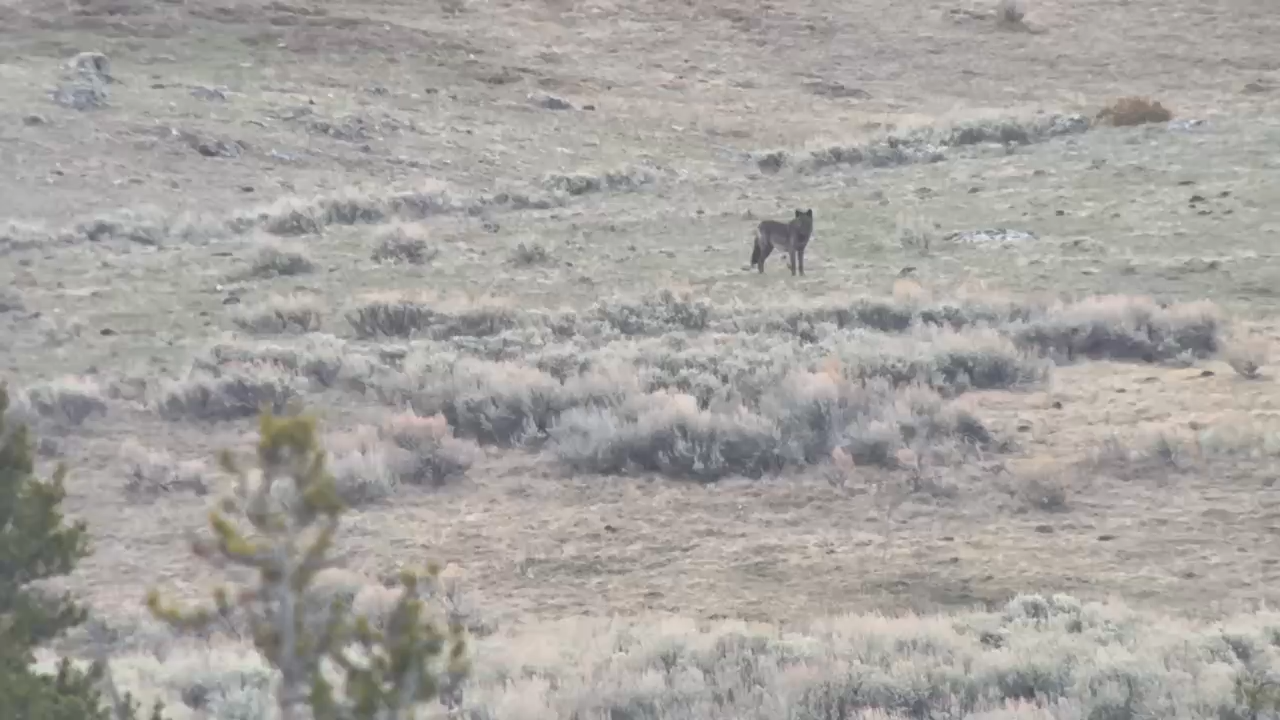
The wolf pictured from a distance at Blacktail Plateau
According to a guide, the wolf belonged to the Rescue Creek Pack, which has claimed the plateau as its territory for years. It meandered through patches of sagebrush, and our group followed its every movement in focused silence. It was stunning to watch lean muscles shift beneath its coat as its long limbs and huge paws carried it forward. Time felt transcendent when it lifted its broad head and released a series of deep, guttural howls, the sound ethereal and delayed as it traveled the long distance to reach us. At one point, the wolf settled onto its haunches, sitting tall and still like a statue on the hillside, its dark coat stark against the golden grass, and then turned its attention toward us.
“The watcher is now the watched,” Smith joked in a low voice, his eye never leaving his spotting scope. I imagined its piercing gaze meeting mine and thought of something Smith shared with our group the evening prior. He’d said, “Looking into a wolf’s eyes is to understand what it means to be wild.” In that moment, I wasn’t just tracking a wolf. I was witnessing a primal wilderness few would ever experience.
I went on this trip with Wolftracker for two reasons: to see wild wolves and grizzlies, my two favorite apex predators, and to meet Smith, a founding member and former leader of the Yellowstone Wolf Project and someone I see as a conservation hero.
In 1995, Smith and other respected biologists launched the Yellowstone Wolf Project to reintroduce gray wolves to Yellowstone after humans eradicated the predator decades earlier through government-sanctioned hunting, poisoning and trapping. According to the Yellowstone Wolf Project, “...fourteen gray wolves were captured in Canada and relocated to Yellowstone’s Lamar Valley. In 1996, seventeen more Canadian wolves were brought into the park, followed by ten wolves from northwestern Montana in 1997.” The population increased as packs grew and territories formed, peaking at 123 wolves. For 2025, the official count tapered off at 84 wolves across eight packs, a 22% decline from the previous year, likely due to a recent outbreak of canine distemper, according to Dan Stahler, current leader of the Yellowstone Wolf Project.
The effort is widely regarded as one of the world’s most successful species-rehabilitation projects and has become a model for conservation programs elsewhere. Now retired, Smith devotes his days to teaching others about wolves and inspiring the kind of action that could preserve the wild world he spent a lifetime defending. Few figures loom larger in the conservation world than Smith. Yet there he was, watching the wolf alongside us with the same curiosity and quiet energy.
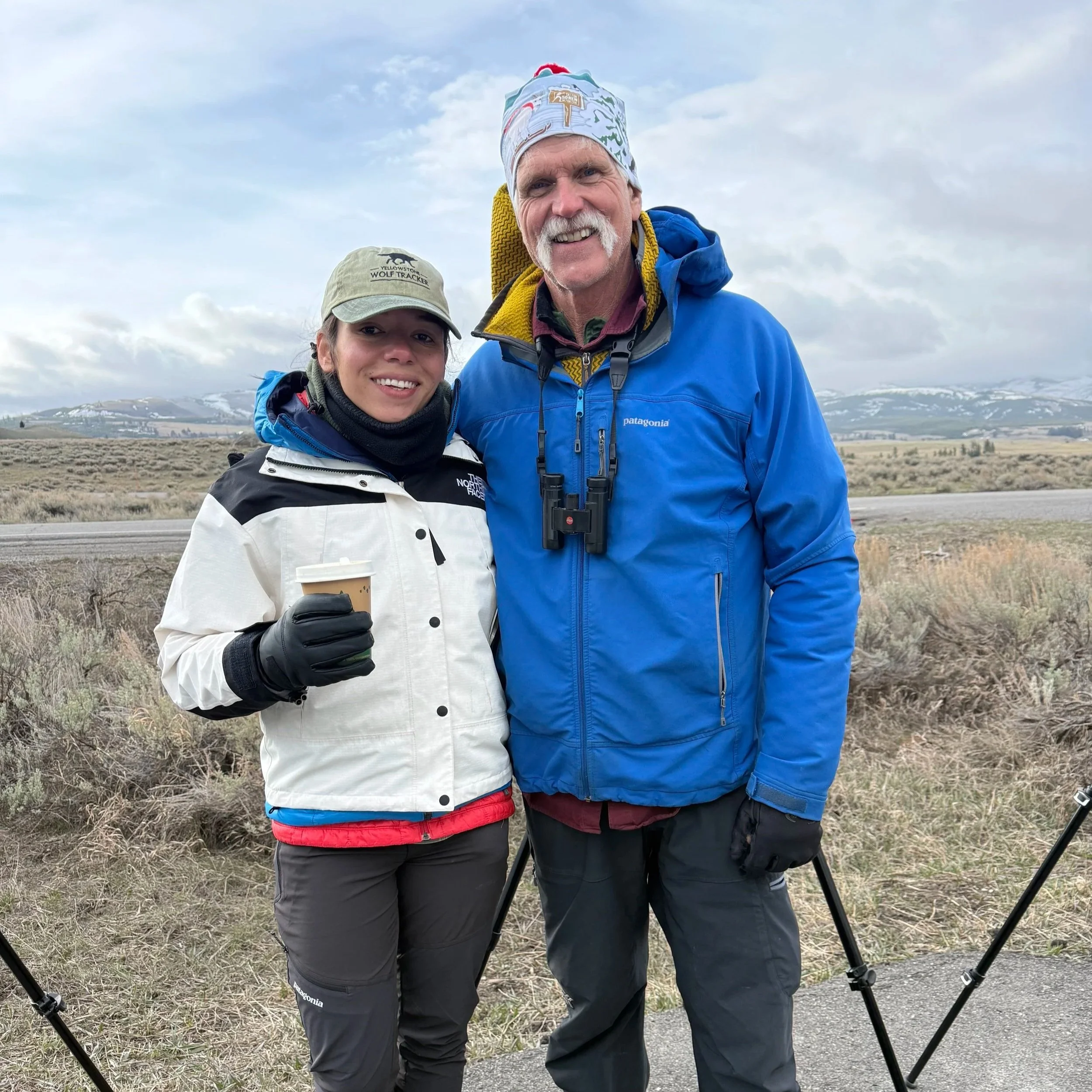
The author shown with world renowned wolf biologist Doug Smith at the Blacktail Plateau
When the wolf lost interest in us, it turned its gaze southeast, climbed a hill and disappeared over the horizon. We packed up the scopes and climbed back into the vans. As we buckled in, we exchanged awe-struck smiles, talking over one another about what we had just witnessed. From that moment on, we were strangers no more.
When Predator Meets Prey
A wildlife guide’s work hinges on a series of educated guesses, supported by tips from other guides, park staff and veteran wolf watchers trading updates over a restricted radio channel. Our guides drove in the wolf’s direction of travel, betting it would reappear in a spot with previous sightings.
Researchers from the University of Washington and the University of Wyoming studied wild animal movement patterns and found that, much like humans, animals tend to return to the same places to eat, as well as travel along familiar routes. “As animals become familiar with a place, site fidelity can help them know where to find good food or hiding spots from predators, and can help them move efficiently to and from these resources,” the study’s press release reported.
As wolves explore their territory, they may follow paths of least resistance and return to locations frequented by prey in a given season – an observation that any wildlife guide can tap into when deciding on the next viewing spot.
“Found it!” one of the guides called out. “Look for the herd of elk.” On the upper slope of a hill, a cluster of bulls and cows had stopped grazing and stood alert. Their attention, locked on patches of sagebrush a hundred or so yards below them, acted as the needle of a compass, and sure enough, a lone, collared black wolf came into view. It was using its long snout to track a scent trail as it moved in an easy stride uphill and toward the herd.
It felt safe to assume this was the same wolf. About 50% of gray wolves in the park have black coats, and according to wildlife technician Taylor Rabe, about a third of the park’s wolves had radio collars in 2025. While my amateur viewing skills did not give me the credentials to say for certain it was the same wolf, it seemed like a reasonable bet to make.
The wolf zeroed in on the alert elk, and our group readied for a live-action scene from a David Attenborough documentary. Charge! The herd bounded uphill, the wolf in pursuit, but the wolf never reached full speed, nor did it attempt a bite. Eventually, the predator backed off. It stopped to sniff a patch of grass while the herd regrouped, then made another bluff charge, just as careless as the first.
When wolves hunt, they move through what biologists call the states of foraging: search, approach, watch, attack-group, attack-individual and capture. The lone canine never committed fully to the attack. If it wasn’t taking its shot, what was it doing instead?
Curiosities of a Lone Wolf
“What do you think it’s doing?” I asked Smith, whose scope was stationed next to mine. He stood upright and paused.
“You know, I think this wolf is just … messing around. I think it knows exactly where its pack is, and it knows exactly what it’s doing out here by itself,” he said.
I turned back to my scope and reflected on his assessment.
The lone wolf is a vulnerable wolf. Territorial conflict is a defining reality of wolf life, with encounters between packs and individuals ranking as the species’ second-most common cause of death after human-caused events. And more often than not, a lone wolf isn’t truly alone for long. Wolves frequently disperse from their pack to explore new ground and search for a mate, either by joining an existing group or forming a new one.
During breeding season, which generally runs from late winter to early spring, single wolves have been observed sending and answering howls. Researchers John and Mary Theberge believe this vocalizing helps locate potential mates, a conclusion supported by repeated observations. If I had to guess, this wolf was on an exploratory foray, looking for a mate and gaining a better understanding of the landscape. As Smith said, it appeared to know exactly what it was doing.
Even so, why waste valuable energy pestering a herd of elk? An individual wolf challenging a herd of able-bodied bulls and cows has almost no chance of success. Ecologist Dan McNulty and others summarized the predator’s challenge in the book “Yellowstone Wolves,” noting that “ungulate populations are often dominated by healthy, prime-aged individuals that wolves cannot catch.” Wolves must therefore focus on small, aged or weakened prey to overcome the limits of their biology, which range from their relatively small frames to their reliance on their jaws and teeth in a hunt. Real success depends on the family unit and the cooperation of the pack, with each member contributing its strengths. This wolf had no reinforcements, no advantage and no debilitated target. So why expend the calories?
The wolf appeared less sharp-toothed hunter and more curious explorer. If nature’s premier opportunist wasn’t planning to strike, perhaps it was gathering information on its own terms, using play, a powerful educational tool for many species, to get the herd moving and observe movement patterns and individuals’ condition. That knowledge could later benefit whatever group he joins, helping in moments of collective foraging and ultimately making him a more capable wolf.
At the end of the day, though, my guess is as good as any.
What Wolves Can Teach Us
The exchange eventually ended: The herd relaxed and migrated out of sight, and the wolf returned to its meandering. I slowly guided my scope as I followed the predator’s path until it stopped at the top of the hill in another statuesque pose, this time as though a monarch watching over its kingdom. I had never seen anything so magnificently built, from the sharp tips of its ears and impressive snout to the long, muscular curves of its frame. Its profile stood perfectly against a big sky that made everything it touched feel both grand and small. Then the wolf turned and slipped from my view.
“If our day ended here, I’d call it a damn good day,” Smith said to the group. But the day wasn’t over yet, and there was still much left to see, though we would never spot another wolf.
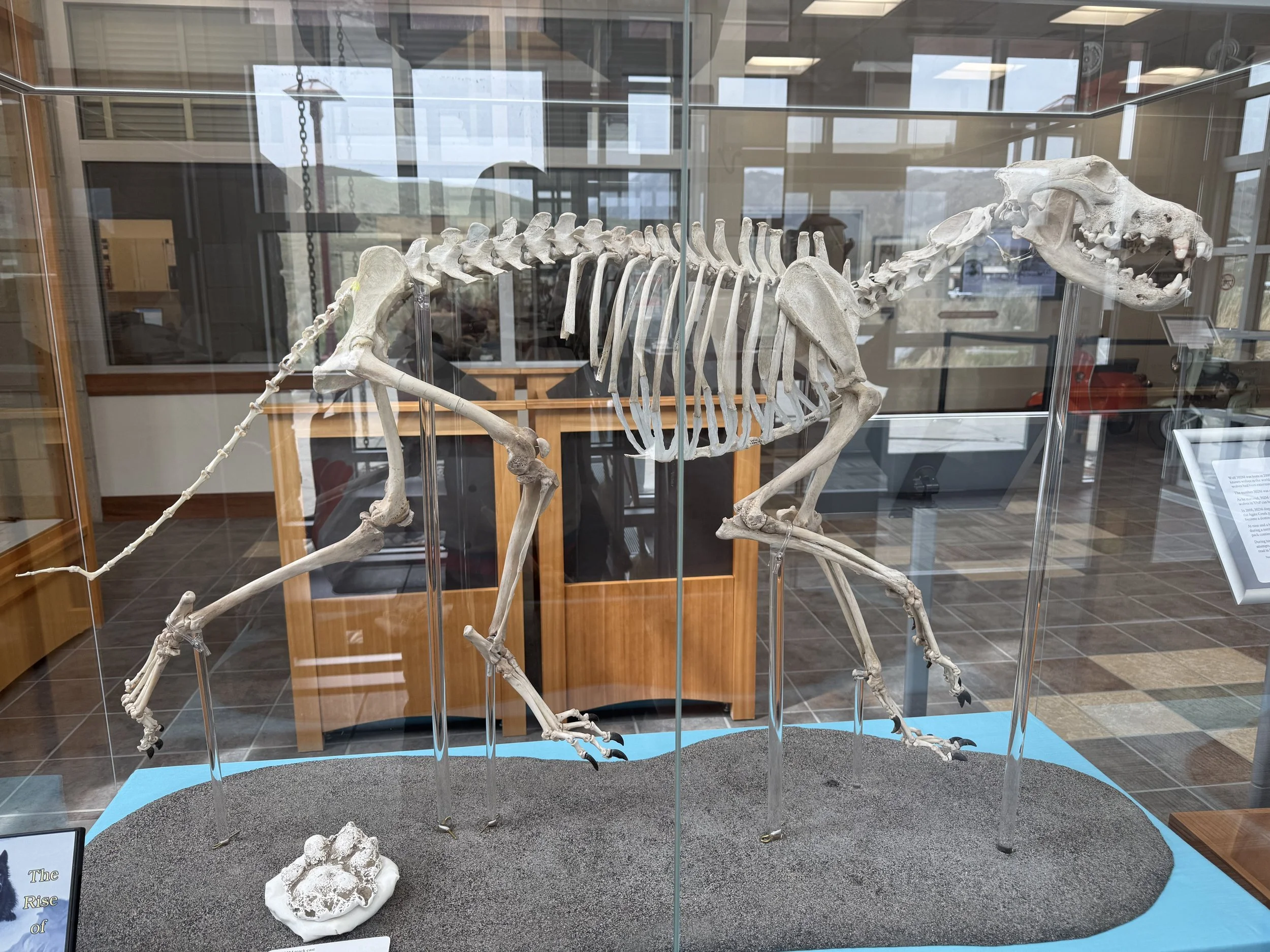
The skeleton of Wolf 302 at the Yellowstone Heritage & Research Center in Gardiner, Montana. The alpha male is among the park’s most famous wolves, known for his unconventional path to leadership and remarkable redemption story.
While countless scientific studies help explain wolf behavior, I find it difficult to believe that humans will ever fully grasp the complexity of their minds. What is clear to me is that by observing their lives, we can learn a great deal about their primal capacity, the essential nature of their role within the greater ecosystem and how we are not so different from the beast we often separate ourselves from.
How do we preserve these wild spaces? How do we reduce the harm already inflicted on these species until it no longer defines their existence? How do we move from the consumption of land to its protection? And how do we prevent another wave of mass extinction or the slow erasure of wilderness altogether?
Answering these questions begins with acknowledging that humans are embedded in the same ecological systems as every other species. We should interrogate our primal abilities, our ecological role and our capacity to prevent further harm to ourselves and the environment. Hope is not a matter of waiting, but of confronting reality and seeking understanding through direct engagement.
The hope I carry is that this essay inspires more careful observation, rigorous questioning and a gradual return to the natural world.
The Wolf Debate
Though this sighting was significant for me, I acknowledge that sentiment is not always shared. For many, particularly ranchers, hunters and farmers, wolves remain a point of contention.
Wolves sit at the center of a centuries-old controversy that fuels discord and debate worldwide. To ranchers, wolves kill livestock and dogs as well as stress farm animals with their presence. To big game hunters, wolves are the ultimate competition. To others, wolves are symbols of deceit, danger and evil, a view shaped early on by the fables we are told as children and reinforced through their portrayal in art and cinema.
Coalition groups across states with wolf populations are working to bridge this divide and develop solutions that meet opposing sides where they stand. My next story will explore the technology, conversations and initiatives aimed at encouraging coexistence as well as the critical role hunters and ranchers can play in protecting America’s apex predators.
If you enjoyed this essay, consider subscribing for future updates.